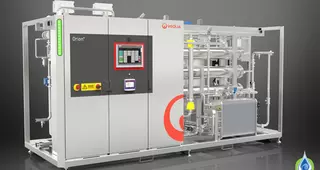
Features two packaged distillation systems that reliably produce hot water for injection and pure steam. To give users peace of mind, they are designed according to European and U.S. Pharmacopoeia and European sterilization standard EN285, and feature validated software to ensure compliance.
Overview
At Veolia Water Technologies, we know the availability of pure fluids is crucial for the pharmaceutical and biotech industries when it comes to finished products manufacturing. To meet the needs of our customers, Polaris 2.0 has a robust design and thanks to easy and fast maintenance, it helps to minimize downtime and ensure the availability of high-quality WFI and PS when needed.
How does Polaris 2.0 work?
Harnessing the power of high pressure distillation and advanced droplet separation, the Polaris 2.0 range sets a new standard in water purification technology. To safeguard against microbiological contamination, cutting-edge sanitization features are seamlessly integrated into the system.
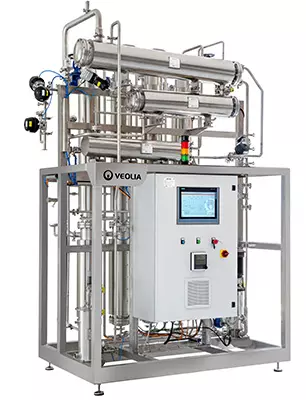
At the heart of the Polaris 2.0 MED lies an innovative high pressure distillation process, enhanced by falling film heat exchange. This ingenious design accelerates the preliminary heating phase, while cleverly utilizing feed water to partially cool the produced WFI, maximizing energy efficiency.
The Polaris 2.0 PSG takes a different approach, employing the interconnected water vessels principle. In this configuration, industrial steam efficiently elevates feed water to vaporization temperature. For full compliance with the European sterilization standard EN285, an optional thermal degassing feature is available.
Uniting these advanced technologies is a commitment to quality, evidenced by the use of premium stainless steel in the demister. This crucial component ensures superior droplet separation, delivering consistently pure results across both systems.
Features and benefits
Ensures global regulatory compliance and highest quality standards
- WFI and PS according to EP and USP
- PS in compliance with EN285
- Design according to Pressure Equipment Directive (PED) and EN13445
- Compliance with FDA CFR21 Part 11, ASME BPE and GAMP V
- CFR21 Part 11 and GAMP V compliance
Maximizes safety, hygiene, and operational efficiency
- Full vacuum design
- Double tube sheet heat exchangers to avoid risk of cross-contamination
- No chemicals needed during operation
- Process contact material used is stainless steel AISI 316L mechanically polished to reach an average roughness of less than or equal to 0.51 micrometer
- Sanitary tri-clamp connections
- 304 stainless steel frame designed to allow easy maintenance
- Full system drainability and 2D dead leg rule compliance included
Enhances automation, control, and remote management
- Distiller automatic drain and programmable sanitization available
- IP54 control panel
- Standard Siemens S7-1500 human machine interfaces (HMI) comfort panel
- Ethernet communication to clients network
- Compatible with our Hubgrade digital solution for remote support
Applications
Services
Our experts are available to provide comprehensive local support and services, strengthened by a global network.


Product range and Resources
Standard MED and PSG models are available as part of the Polaris 2.0 range to meet different capacity demands:
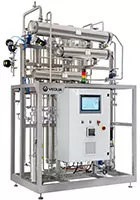
Polaris™ 2.0 MED
Designed for the pharmaceutical industry and biotech applications, it ranges from 250 liters per hour (l/hr) to 4,500 l/hr of WFI assuming 8 barg of industrial steam available on site.
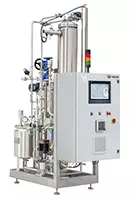
Polaris™ 2.0 PSG
Designed for the pharmaceutical industry and biotech applications, it ranges from 300 kilograms per hour (kg/hr) to 3,000 kg/hr of pure steam at 4 barg assuming 8 barg of industrial steam available on site.
Contact
Our Polaris distiller and steam generation units have long been the go-to solution for pharmaceutical businesses around the world. Polaris 2.0 is an evolution of this tried-and-trusted solution for WFI and pure steam generation with improved performance and efficiency.

Luca Danesi
Chief Sales Officer Europe - Pharma Division
Contact Luca through his LinkedIn account
FAQ about Polaris™ 2.0
Hot WFI production sensibly decreases the risk of microbiological contamination and biofilm creation. In addition to this, the distillation technology is a very well known process increasing the level of confidence for the end user.
The HMI comfort panel can easily be replaced in case of damage without reconfiguration. Data is saved locally and automatically transferred to your local network. The integration capability of our control platform allows full connection with your network, ensuring a proper data transfer as per FDA CFR21 Part 11.
The key difference between cold and hot water for WFI lies in the temperature at which the water is produced and maintained.
For example, cold WFI is typically produced and stored at a temperature between 20°C to 25°C and is mostly suitable for applications where there is a need to avoid the potential degradation or alteration of heat-sensitive pharmaceutical compounds. Alternatively, hot WFI is produced and maintained at a temperature above 85°C to 90°C. It is often used for the production plant cleaning in place (CIP) and in processes that require high temperatures to ensure microbial control.
Both cold and hot WFI must meet strict quality and purity standards, including requirements for microbial content, endotoxin levels, conductivity and chemical impurities. The choice between cold and hot WFI depends on the specific requirements of the pharmaceutical or biotech manufacturing process and the characteristics of the products being produced.