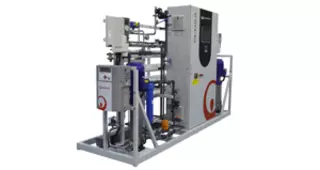
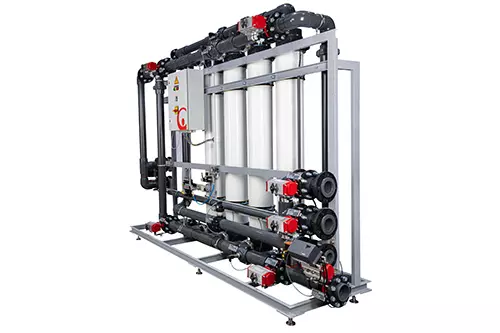
A specialized skid-mounted ultrafiltration system designed for virus and bacteria removal in wastewater treatment and water recycling and reuse facilities.
Overview
Flexible and versatile, the Uflex ultrafiltration units are mounted on a portable platform and can be used in municipal and industrial water processing, including at food and beverage, power, laboratory and cosmetic and pharmaceutical plants, as well as leisure facilities such as swimming pools.
The system can remove 99.99% of bacteria, log 4 viruses and suspended solids, helping facilities meet regulatory standards for water quality.
Uflex is often employed as a pre-treatment step in more advanced water purification processes, such as reverse osmosis (RO). In this role, it helps protect the sensitive RO membranes by removing larger particles that could potentially damage or clog them, thereby improving the overall efficiency and lifespan of the RO system.
How does Uflex work?
Ultrafiltration is a water purification process that effectively removes small particles and large molecules from untreated water, making it safe for drinking. This technology can serve as a comprehensive solution, replacing traditional water treatment methods such as coagulation, flocculation, sedimentation, sand filtration, and chlorination. Alternatively, it can be implemented as a standalone system in remote areas experiencing population growth.
The ultrafiltration process in Uflex works by forcing water through a semipermeable membrane with extremely small pores. These pores are so tiny that they can trap contaminants like bacteria, viruses, and other harmful microorganisms, as well as larger molecules and particles. Clean water passes through the membrane, while the unwanted substances are left behind.
Uflex ultrafiltration units are available in various configurations, offering a range of capacities for single and parallel skid setups. Multiple models can be deployed and operated by a single controller, with the option to chemically enhance the backwash process when needed. The system can accommodate from 1 to 4 elements in parallel, providing a wide range of flow rates from 3.2 to 112m3/h to suit different requirements.
Features and benefits

Fully automatic operation with no operator involvement

Automatic hydraulic backflush and chemically enhanced backwash with connections

Integrated and simple-to-use controller for easy operation and maintenance

Flexible, modular skid design enabling easy production capacity extension

One controller to manage up to two skids in parallel mode for cost saving

Small footprint
Applications
Services
Services offered encompass Factory Acceptance Tests (FAT) for all manufactured products, product commissioning support, and best-in-class logistics services.
Product range and Resources
Four models available:
- 64/1-P
- 128/2-P
- 192/3-P
- 256/4-P
Contact
Ultrafiltration is important to our customers because it provides a reliable and efficient method for treating water, ensuring the removal of bacteria and other contaminants. As such, Uflex contributes to improved product quality, compliance with regulations, cost-effectiveness and overall operational efficiency.
David Lamas
Product Manager - Veolia Water Technologies
Contact David through his LinkedIn account
FAQ about Uflex
Ultrafiltration and reverse osmosis are both membrane filtration technologies, but they differ in the size of particles they can remove. Ultrafiltration typically removes particles and macromolecules larger than 0.01 microns, including bacteria and some viruses. Reverse osmosis, on the other hand, can remove even smaller particles, including dissolved salts and minerals, with pore sizes as small as 0.0001 microns.
While ultrafiltration is often used for producing potable water from freshwater sources, reverse osmosis is commonly used for desalination or purifying water with high dissolved solids content.
The lifespan of ultrafiltration membranes can vary depending on factors such as water quality, system design, and maintenance practices. Generally, well-maintained ultrafiltration membranes can last between 3 to 5 years. However, some high-quality membranes may last up to 10 years with proper care. Regular cleaning and backwashing procedures can help extend the life of the membranes. It is important to monitor the system's performance and replace membranes when they show signs of degradation or reduced efficiency to maintain optimal water quality.
Case Studies
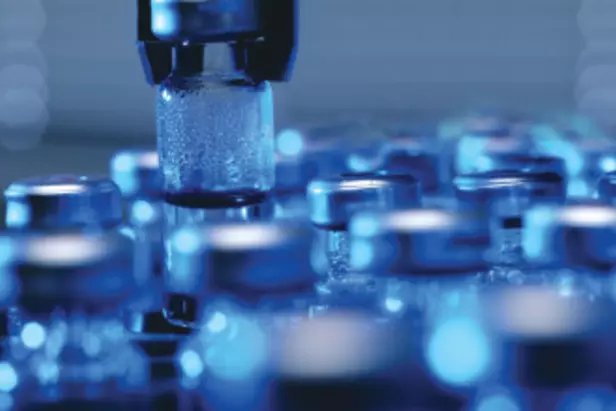
A leading Mexican pharmaceutical company, with 75 years of experience, partnered with Veolia Water Technologies Mexico to expand its clinical product manufacturing in Tlajomulco de Zúñiga, in the region of Jalisco. The design focused on optimizing the client's resources to enhance flexibility in purified water production. These developments required a continuous supply of ultrapure water, which was met through the provision of standard equipment such as pre-treatment systems and ultrapure water production units. Our solution helped optimize the client's resources for flexible production.