A multi-step water treatment technology for high-fouling industrial wastewater. It combines elevated pH chemical softening, filtration, ion exchange, and reverse osmosis to achieve high water recovery in the energy, mining and automotive sectors.
Overview
How does Opus™ work?
Opus is a proprietary technology designed to treat high-fouling or scaling wastewater across several industrial markets, including energy and chemicals, mining and automotive industries, enabling them to achieve high water recovery. It is a multiple-process technology involving chemical softening, lamella clarification, media filtration, ion exchange softening, cartridge filtration, and elevated pH reverse osmosis (RO) as its core technology. Optional unit processes such as upstream degasification are used, as needed, for a specific application.
The water pretreatment processes within OPUS are designed to reduce hardness, metals and total suspended solids in the feed water to protect the RO membranes. The elevated pH chemistry increases the solubility of silica and organics to mitigate RO fouling and improves the removal of boron.
Main steps of an OPUS system:
- For wastewater applications high in alkalinity, optional CoStrip™ fouling-resistant degasification can be provided to acidify and remove alkalinity. This helps to reduce the operational costs of sludge disposal and alkali chemical consumption in the downstream chemical softening process. CoStrip will also remove problematic gasses such as hydrogen sulfide and BTEX compounds for safer operation, corrosion mitigation, and improved downstream membrane longevity.
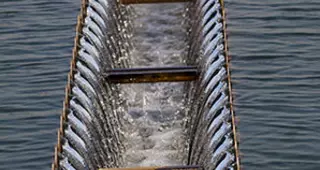
- The degasified water is then softened in a multi-stage process using Multiflo™, our proprietary high-rate chemical softening and thickening technology that operates at elevated pH to precipitate hardness and metals in the form of crystallized solids. These dense solids are removed in a settling zone using lamella plates and are thickened to generate a sludge stream with a solids concentration of 6 to 10% by weight. The thickened sludge can be further dewatered by an optional filter press system for disposal in a non-hazardous landfill.
- The softened water from the Multiflo process is then further treated with media filtration for the removal of residual suspended solids.
- Ion exchange softening utilizing weak acid cation (WAC) resin is then used to further reduce hardness and metals to lower concentrations. The WAC ion exchange softener operates in the sodium form, without a pH change across the resin. This process eliminates the potential for scaling of the reverse osmosis membranes in the next stage.
- This pretreated water, still at elevated pH, passes through a guard cartridge filter. The filtrate is then pressurized through the reverse osmosis process, operated at an elevated pH in either single or double-pass RO mode, to reduce the total dissolved solids, silica, boron and organics present in the feed water. The high pH RO operation, in conjunction with the robust pretreatment process, effectively controls biological, organic and particulate fouling, eliminates scaling, and increases the rejection of total dissolved solids, silica, boron and organics present in the feed water.
The result of this multi-stage process is high water recovery and high-quality product water that can be reused or discharged into the local waterways.
Opus™ II
Opus II upgrades the filtration process, replacing the multi-media filtration step with ceramic ultrafiltration (CUF). The CUF system operates in cross-flow mode for the removal of residual free oil and suspended solids. The CUF system is a superior filtration process and provides a higher quality filtrate compared to multi-media filtration. The benefits include a smaller footprint, improved filtration quality, decreased particulate fouling potential for the downstream RO process, and reduced maintenance on downstream equipment.
The other unit processes used in OPUS II technology are the same as the first-generation OPUS technology. OPUS II technology consists of:
- Optional CoStrip™ fouling-resistant degasification
- Multiflo™ chemical softening
- Ceramic ultrafiltration (CUF)
- WAC IX softening in the sodium form
- Elevated pH reverse osmosis

Features and benefits
Ecological focus
- High water recovery rate
- Low waste volume
- Low energy consumption
- Compact footprint
(especially using OPUS II)
Robust and reliable
- Reliable operation with minimal downtime.
- Ability to handle variations in feed water quality.
- Effective control of fouling due to organics and particulates.
- Effective control of scaling due to calcium salts, silica and metal precipitates.
- High salt rejection of boron, silica and organics
- Continuous clean-in-place process.
Applications


Services


Contact
We are driven by providing solutions that protect the environment first and foremost. Opus does just that and provides robust pretreatment for effective fouling and scaling control. As a result, Opus reliably achieves high water recovery rates while treating challenging wastewater from various industries. It ensures its product water is cleaned to a high quality that is compliant for reuse or discharge into the local waterway.
FAQ about Opus
Reverse osmosis is a water purification process that uses a semi-permeable membrane to remove ions, molecules and larger particles from water. It is mostly used in desalination, wastewater treatment and other applications where purification, water recovery, and water reuse are necessary. In a typical system, water is pressurized and forced through the membrane, separating contaminants from the clean water.
Case Studies

In 2011, a major oil company in the United States faced production constraints due to produced water reinjection limitations. They needed a solution to treat up to 50,000 barrels per day of challenging produced water, aiming for high water recovery and minimal waste injection. We helped our client design, build and operate an advanced water reclamation facility using OPUS II technology. The system was designed to achieve 90% water recovery, producing softened water for steam generation and clean water for surface discharge. Over 11 years of operation, the facility has consistently met stringent NPDES permit requirements for 100 contaminants. It has discharged approximately 50 million barrels of clean water, benefiting the environment in a water-scarce area while enabling increased oil production capacity.

A rare earth and metal products manufacturer needed to expand operations while maintaining environmental responsibility. To achieve its goal, it required a water treatment solution to handle process wastewater and well water, aiming for high water recovery and zero wastewater discharge. To help our client we designed and built a new water treatment plant using OPUS technology, combining high-rate chemical softening, filtration, ion exchange and reverse osmosis. The system was designed to treat 1,000 gallons (3785,41 liters) per minute, enabling increased production capacity.
The Opus system achieved over 93% water recovery, producing clean water for reuse in processing and power generation. The concentrate stream was further treated and utilized in the chlor-alkali plant, contributing to zero wastewater discharge. The project's sustainability was enhanced by reusing water constituents to reduce chemical costs.