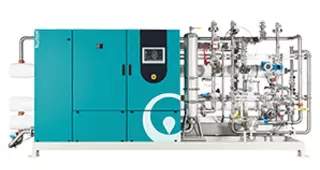
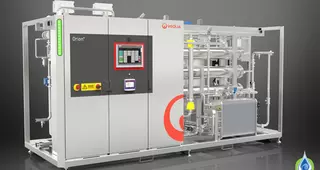
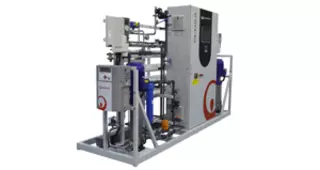
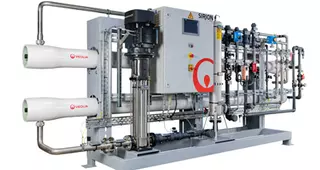
The SWRO process removes salts from seawater used in crude oil desalting and utilities using a mix of technologies.
Overview
How does SWRO work?
Osmosis is a natural phenomenon where pure water moves from a less concentrated saline solution, through a semipermeable membrane, into a more concentrated saline solution. This semipermeable membrane allows certain substances to pass through while blocking others. In this case, it permits water but not salt.
Two compartments are separated by a membrane. One compartment contains a salt solution, the other pure water. The membrane allows water to flow freely between the compartments, but the salt cannot pass through.
The system naturally strives to achieve equilibrium, meaning it aims to have the same concentration on both sides of the membrane. The only way to achieve this is for water to move from the pure water compartment into the salt solution compartment, diluting the salt solution.
This osmotic process can cause the salt solution's level to rise. This rise continues until the pressure exerted by the column of water (salt solution) is high enough to halt the water flow. The equilibrium point, where the water pressure against the membrane balances out, is known as the osmotic pressure.
Applying force to this water column can reverse the direction of water flow through the membrane, a process known as Reverse Osmosis.

Features and benefits

Low overall energy consumption

Ease of manufacture and construction

Optimum performance with any pre-treatment processes

Suitable technology in the most complex locations

The lowest capital and operating cost solutions
Applications


Services


Contact
As the offshore water treatment expert of the world's leading water treatment company, VWS Westgarth, with over thirty years of experience in designing, supplying, and operating water treatment process systems for the offshore energy industry. Our SeaWater Reverse Osmosis technology is engineered to meet your highest technical specifications and quality standards. It is built to withstand the challenging offshore environment while delivering the exceptional reliability and availability demanded by your industry.

Brian Baillie
Head of Sales and Marketing at Veolia Water Technologies, VWS Westgarth
Contact Brian through his LinkedIn account
FAQ ABOUT Sea Water Reverse Osmosis
- Typically, more than 95% of ionic impurity, most organic impurity, and nearly all particulates, bacteria and bio-molecules are removed from the permeate water.
- Low overall energy consumption
- Ease of manufacture and construction
- Optimum performance with any pre-treatment processes
- Suitable technology in the most complex locations
- The lowest capital and operating cost solutions
The membranes work by selectively allowing ions to pass through based on their charge. An anion membrane allows negative ions to pass through but not positive ions. Conversely, a cation membrane allows positive ions through and not negative ions. This process is known as electrodialysis.
Reverse osmosis can be used in a number of markets such as energy, pharma, healthcare, food and beverage.
If the reverse osmosis system is well maintained, it can run for 10-15 years.