


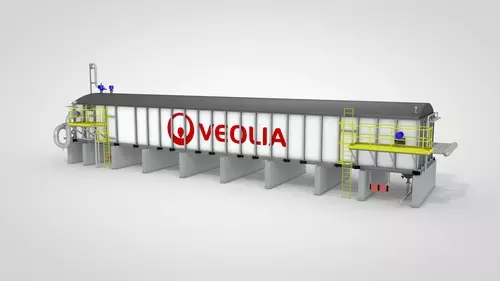
API Gravity Separator is a primary oil and/or water separator designed to meet the needs of the oil, gas and petrochemical industries. It complies with API 421 design code.
Overview
API Gravity Separators are crucial in safeguarding the environment by treating industrial wastewater. They effectively remove large quantities of oil and suspended solids, preventing harmful pollutants from entering waterways, protecting both aquatic ecosystems and human health.
API Gravity Separator has been specifically designed to comply with the American Petroleum Industry standard (API 421) design code recommendations, ensuring discharged water meets environmental standards.
It is almost universally applied as a pre-separator in a full train of effluent treatment elements. Oil droplets with a diameter greater than 150 micrometers (μm) are removed effectively.
How does API work?
API Gravity Separator effectively separates oil droplets from water by gravity. As per API 421 code, the length and height of the basin are calculated to have a laminar flow through the unit. An inlet distribution and laminar-inducing device ensure an optimized and shortened separator.
As oil density is lighter than water, oil droplets rise to the surface during the flow from the inlet to the outlet of the unit. Oil accumulated in the top layer of the water is then pushed by a scraper to an oil skimmer device.
This skimmer device removes the collected oil from the water surface. Oil droplets with a diameter greater than 150 μm are removed effectively while suspended solids in the water go down to the bottom of the API Gravity Separator unit.
The same scraper system pushes the collected solids at the bottom toward sludge cones. The sludge cones then collect the solids for extraction through the sludge nozzles located underneath the unit. The volatile organic compounds are contained with the modular removable cover. Either nitrogen blanketing or air sweep system is used to keep the separator atmosphere above the upper explosion limit and below the lower explosion limit.
Features and benefits

Well-proven scraper mechanism in the separator.

Suitable for use in the explosive atmosphere.

Standardized product, with a short lead time to customize it with customer specifications.

Pre-fabricated, modular design, fully transportable and integrated.

Design suitable for a wide range of effluent (temperature, viscosity, concentration) and optimized to achieve the best separation performance.
Applications


Services


Contact
API Gravity Separator not only meets industry standards but also drives ecological transformation. By effectively removing oil and suspended solids from water, we're safeguarding our environment while ensuring operational efficiency for our customers.

Harm Uenk
Product Manager - Veolia Water Technologies
Contact Harm through his Linkedin page
[email protected] - +316 20284511
FAQ about API Gravity Separator
API Gravity Separator is designed to reduce the impact of oil and gas operations on water sources by treating the water with gravity segregation of oil and solid particles increasing the water quality.
API Gravity Separator is developed for the energy and chemical processing industry and offered as a standard product in four flow ranges. Industry standards and client requirements are included.
As a standard product, the time from order to delivery is relatively short. A combination of our standardized internal components reduces the lead production time while offering options to the client.
Existing API units are often constructed as below-ground-level civil basins, often lacking technology such as scraper systems or covers. Upgrading these units increases performance with high-quality internal components, improving maintenance through above-ground accessibility and preventing hazardous vapors from reaching the atmosphere thanks to a closed covers system.


